


Cleaning of Clog Drains
Cleaning of Clog Drains


Need help with your clog problem?
Get in touch
Get instant help. Quote & Appointment Available Immediately
How We Clear a Choke: Three Methods
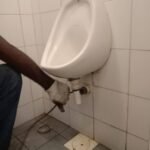
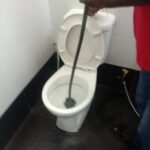
The plunger, the closet auger and opening up the trap by hand. This is the right first move on a toilet bowl blocked by paper or wipes, on a kitchen sink where the plug is sitting in the bottle trap, and on a basin choked with hair. It is also the only method that reliably recovers a dropped object rather than pushing it further down the line, which matters more often than people expect. Typically 20 to 45 minutes on site. Its limit is that an auger bores a hole through a blockage rather than cleaning the pipe wall, so on a greased-up kitchen line it buys you days or weeks, not a fix. One thing worth knowing: a closet auger used without an intact guard sleeve will permanently scratch the porcelain of your toilet bowl. We use guarded tools and we never put a powered cable straight into a bowl.
A motorised drum machine spins a steel cable through the pipe with a cutter head on the end, shearing through what a hand tool cannot reach. This is the method for compacted debris, textile and wipe build-up, and blockages sitting well beyond the trap in a 100mm discharge branch. It is also what we use to retrieve foreign objects from deeper in the line, and it needs no water supply and no drainage route, which makes it the practical choice in a small HDB toilet. Typically 45 to 90 minutes. Two honest limits. Like a hand auger, it opens a channel rather than stripping the pipe wall, so a grease-lined pipe is still substantially blocked when flow returns. And in badly corroded cast iron, which is common in older blocks, a cutter can go through a wall that has thinned from the inside. Where we suspect that, we say so and inspect before cutting rather than turning your choke into a leak in the unit below.
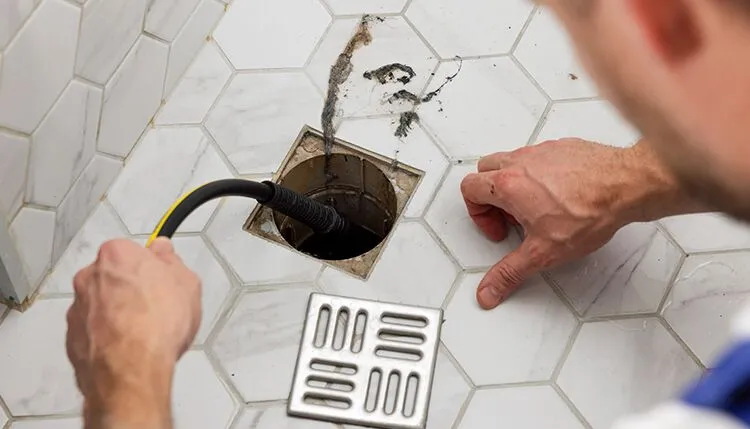
A high pressure pump drives water through a nozzle with forward and rear-facing jets. The forward jet opens the blockage, the rear jets drive the hose down the line and scour the pipe wall as it is drawn back. This is the only one of the three that actually removes a wall coating rather than punching through it, which is why it is the correct answer to grease, silt, sludge, soap scale and any choke that keeps coming back. It is the standard for commercial kitchen and F&B drain lines, and for main drain runs between inspection chambers. Typically 45 minutes to 3 hours depending on the run. Pressure is set to the condition of the pipe, not to a fixed number: internal branch and stack work is normally in the 1,500 to 2,500 psi range, with higher pressure reserved for external mains and commercial grease lines. It is the wrong tool for a solid foreign object, since water simply flows around it, and it is genuinely unsafe on a pipe that is already structurally compromised, which is why we inspect first where the pipe is old or its condition is unknown.
Book Your Plumbing Service Now
Our licensed plumbers are ready to provide fast, reliable, and affordable plumbing solutions anywhere in Singapore.